Hydrogen is moving from pilot projects to national energy strategy — and every engineer who touches a hydrogen line quickly learns the same lesson: hydrogen is not natural gas. Its molecule is the smallest in nature, it embrittles carbon steel, ignites with almost no energy and burns in a far wider concentration range than methane. Design rules written for gas distribution simply do not carry over. That is the purpose of ASME B31.12, the Hydrogen Piping and Pipelines code.
At NoboShakti Prokushal we have been integrating B31.12 requirements into national boiler and pressure-equipment regulation under the GIZ Bangladesh Boiler Code Development Project. These are the essentials we apply on every hydrogen design review.
1. Material selection is the first line of defence
Hydrogen embrittlement — the loss of ductility and fracture toughness as atomic hydrogen penetrates the steel lattice — governs material choice. In practice this means:
- Limiting carbon-steel strength: high-yield, high-hardness steels are more susceptible, so B31.12-qualified applications favour controlled strength grades with caps on hardness and tensile properties.
- Preferring killed, fine-grain steels with clean melting practice; sour-service-qualified material is a good baseline even for sweet hydrogen duty.
- Treating welding consumables and procedure qualification as part of material selection — the weld zone is usually the most embrittlement-sensitive part of the system.
2. Design factors are deliberately conservative
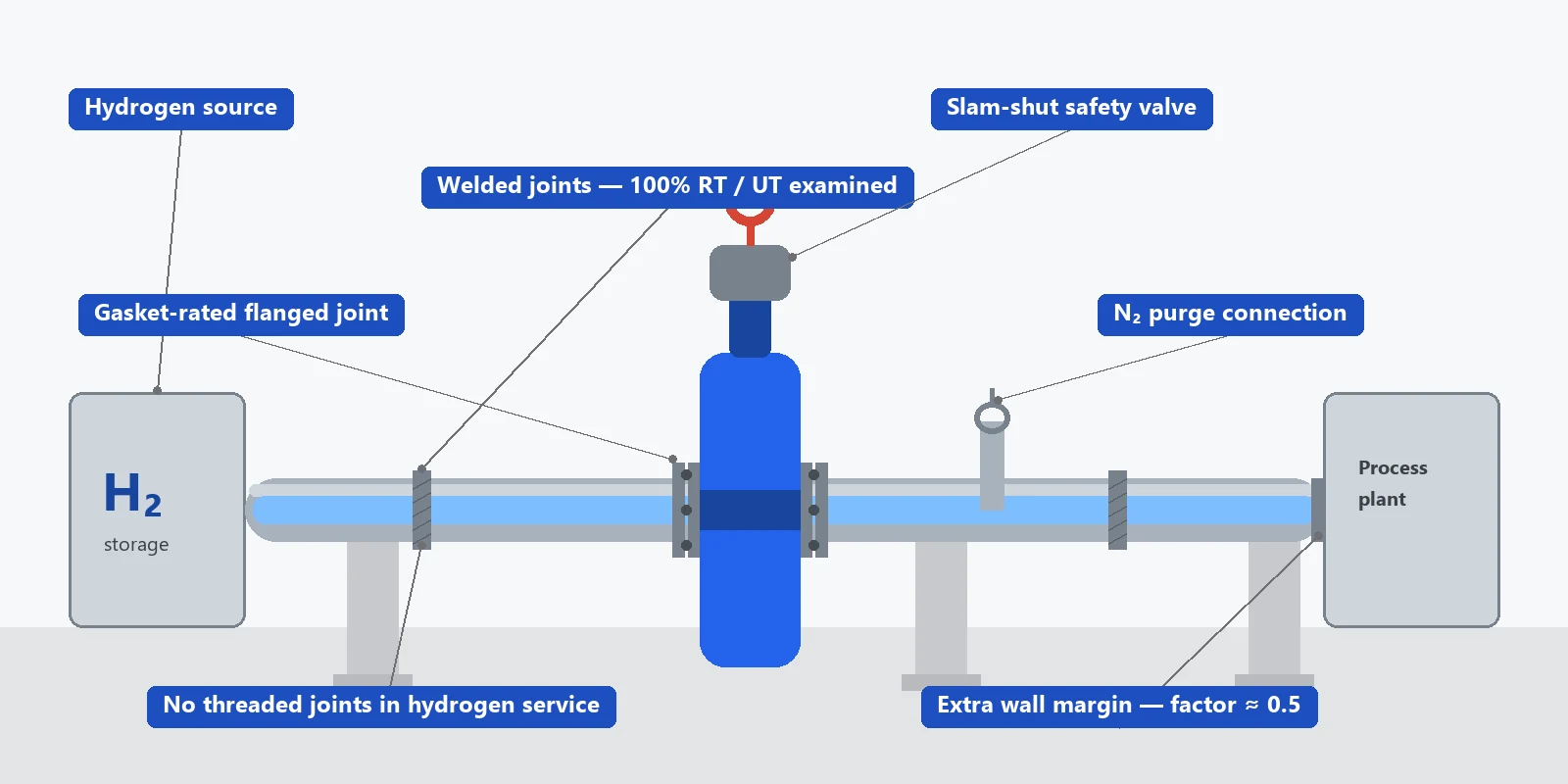
Compared with ASME B31.8 for gas transmission, B31.12 applies more conservative design factors and wall-thickness rules for hydrogen service. Where a natural-gas line might use a 0.72 design factor, hydrogen pipelines are designed closer to 0.5. The extra wall thickness buys tolerance for the defect growth and fracture behaviour that hydrogen accelerates. Do not be tempted to "value-engineer" this margin away — it is the code’s acknowledgment of hydrogen’s unique risk profile.
3. Leak-tightness is a design feature, not an afterthought
- Hydrogen leaks through paths that hold gas and even water tight — flange selection, gasket material and bolting torque all need hydrogen-specific attention.
- Threaded joints are effectively excluded from hydrogen duty; welded or qualified mechanical joints with documented sealing performance are the norm.
- Valves and fittings must be rated and, where applicable, fire-tested for hydrogen service — a natural-gas rating is not sufficient evidence.
4. Welding, NDE and testing
Welding procedure qualification for hydrogen service demands tight control of heat input and interpass temperature, with nondestructive examination — radiography or ultrasonic testing — covering a higher proportion of welds than conventional process piping. After construction, the system is strength-tested and leak-tested, and commissioning follows a disciplined purge sequence: nitrogen displacement before any hydrogen admission, and verification of oxygen content before energising.
“In hydrogen service, the code margin is not conservatism for its own sake — it is the difference between a pipeline that leaks gradually and one that fails suddenly.”
The bottom line
B31.12 rewards engineers who treat hydrogen as a new design problem rather than a new fluid in an old system. If your organisation is planning hydrogen storage, distribution or process piping in Bangladesh or Indonesia, a design review against B31.12 before procurement is far cheaper than remediation after the first inspection cycle.