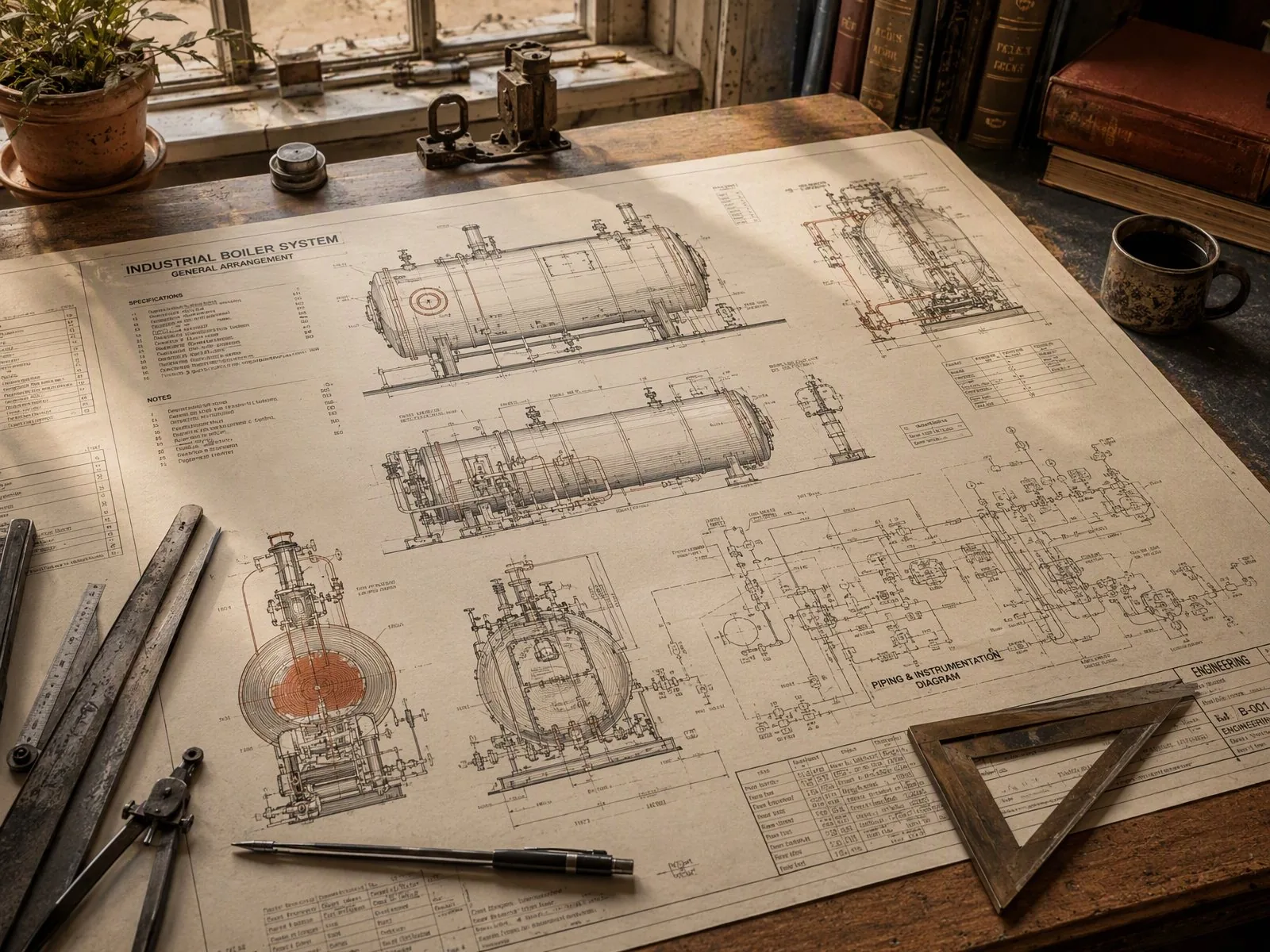
Boilers are critical components in power generation, industrial processing and heating applications — and their design and manufacturing must ensure safety, reliability and efficiency above all. The ASME Boiler and Pressure Vessel Code (BPVC) is the globally recognized standard governing the construction, inspection and certification of boilers and pressure vessels. Updated every two years, the BPVC provides comprehensive rules that safeguard against failures and accidents, and compliance with it is increasingly expected of any serious industrial project in Bangladesh and abroad.
Key ASME BPVC sections for boilers
- Section I — Rules for Construction of Power Boilers: design, materials, fabrication, inspection and testing of high-pressure steam boilers used in power plants.
- Section IV — Rules for Construction of Heating Boilers: low-pressure heating boilers for residential and commercial use.
- Section VI — Recommended Rules for Care and Operation of Heating Boilers: guidelines for safe operation and maintenance.
- Section VII — Recommended Guidelines for Care of Power Boilers: operational safety and inspection practices for power boilers.
Design principles
Material selection. Boiler steels must comply with ASME Section II material specifications, with tensile strength, creep resistance and corrosion resistance as the decisive properties for long service life.
Stress analysis. Section VIII together with Section II Part D provide the stress tables and design formulas that underpin pressure-part sizing, and finite element analysis is now routinely used to validate complex geometries.
Safety factors. Designs incorporate margins for pressure, temperature and fatigue loading, while overpressure protection is governed by Section XIII.
Welding and fabrication. Section IX specifies welding qualifications and procedures, and heat treatment with non-destructive testing (NDT) confirms the integrity of every critical joint.
Manufacturing practices
- Fabrication: cutting, rolling and welding of boiler shells and tubes must follow ASME-approved procedures.
- Inspection: Authorized Inspectors verify compliance through hydrostatic tests, radiographic examinations and dimensional checks.
- Certification: manufacturers must hold the ASME “S” Stamp for power boilers or the “H” Stamp for heating boilers.
- Documentation: data reports and material certificates are mandatory for traceability.
“In boiler manufacturing, documentation is not paperwork — it is the proof that the certificate on the nameplate is true.”
Why BPVC compliance matters globally
- Safety assurance: BPVC compliance reduces the risk of catastrophic failures.
- Market access: ASME certification is frequently a precondition for international projects and export supply.
- Sustainability: modern BPVC editions incorporate efficiency improvements and support integration with renewable energy systems.
Boiler design and manufacturing under ASME BPVC standards is not just about compliance — it is about ensuring long-term safety, operational reliability and global acceptance. For industries in Bangladesh and beyond, adopting BPVC positions projects at par with international best practice. As Key Expert on the national Boiler Code development project with GIZ, this is exactly the standard we are working to embed in national regulation.