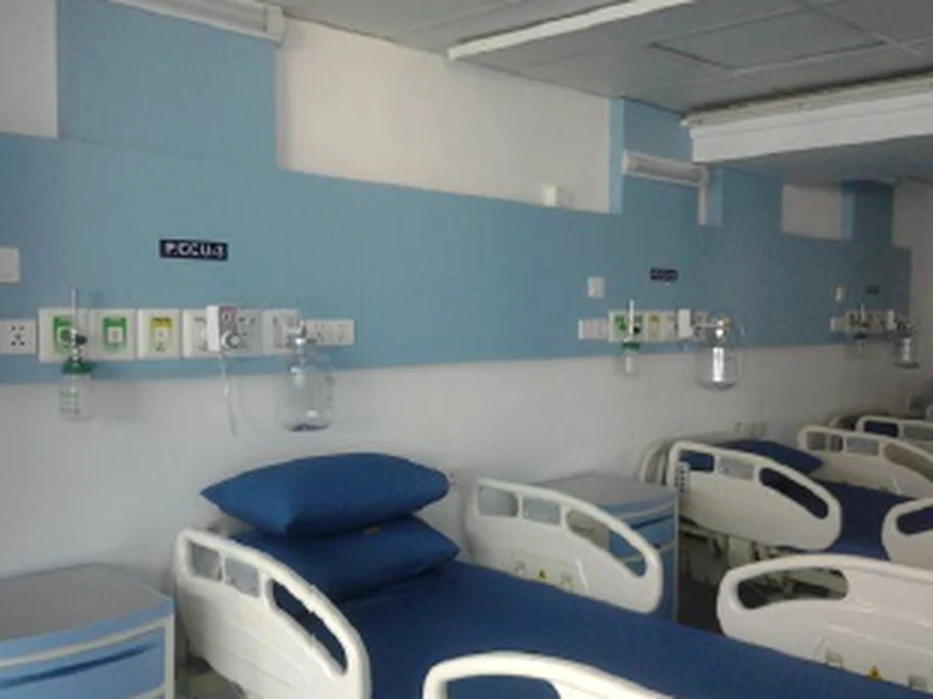
After auditing and equipping more than twenty health facilities in Bangladesh — upazila health complexes, SCANU units and private hospitals — we have learned that hospital MEP failures are rarely exotic. They are ordinary systems, neglected in ordinary ways. This is the working checklist our teams use at the start of every healthcare MEP engagement in 2026. It aligns with NFPA-99 and ISO 7396-1 principles and supports DGHS licensing documentation in Bangladesh.
OT / ICU HVAC — the pressure cascade
- Verify positive pressure in operating theatres relative to adjacent areas, and negative pressure where isolation is intended — with the door closed and, critically, with it open.
- Confirm air change rates (typically 20+ ACH for OTs) against design values, and check filters for differential pressure gauges that are actually connected and reading.
- Measure temperature and humidity at working level, not just at the AHU — stratification near theatre lights is a common finding.
- Test auto-changeover of supply and exhaust fans, and confirm alarms reach a staffed location, not a locked plant room.
Medical gas pipeline systems
- Walk the oxygen manifold: cylinder bank layout, changeover panel function, reserve bank readiness and — most often missed — whether the line pressure alarm actually sounds anywhere.
- Check zone valve boxes for access, labeling and correct "open" position after any maintenance.
- Spot-test outlets and inlets for correct gas-specific indexing; a swapped probe is a patient-safety event waiting to happen.
- Review the last cross-connection test and pressure-drop test records; if there are none, schedule verification testing before licensing review.
Electrical resilience
- Load-test the generator under real building load, not just no-load start — and record fuel autonomy at that load.
- Trace the essential supply board: which circuits truly switch over? OT, ICU, blood bank and emergency lighting must be on it.
- Check UPS battery age and last discharge test; batteries older than three to four years deserve capacity testing.
Fire safety and life safety
- Hydrant and hose-reel pressure test at the hydraulically most remote point.
- Detection and alarm: walk-test call points and detectors on a sample basis; confirm the panel shows the correct zone text.
- Evacuation: corridors clear, exit doors opening in the direction of escape, assembly points known to staff on shift.
“A hospital can pass a licensing inspection and still fail a patient at 2 a.m. The audit exists for the 2 a.m. case.”
Documentation — where audits are won or lost
Every finding above should land in a register with severity, owner and due date. For DGHS licensing in Bangladesh, assemble the dossier before it is asked for: test certificates, calibration records, training logs, and as-built drawings. Facilities that keep this dossier current clear licensing cycles in days instead of months.
A structured MEP audit typically takes one to three days depending on bed count, and the output is a prioritized rectification roadmap — not a binder of blame. If your facility has not had an independent MEP review in the last 24 months, 2026 is the year to schedule one.