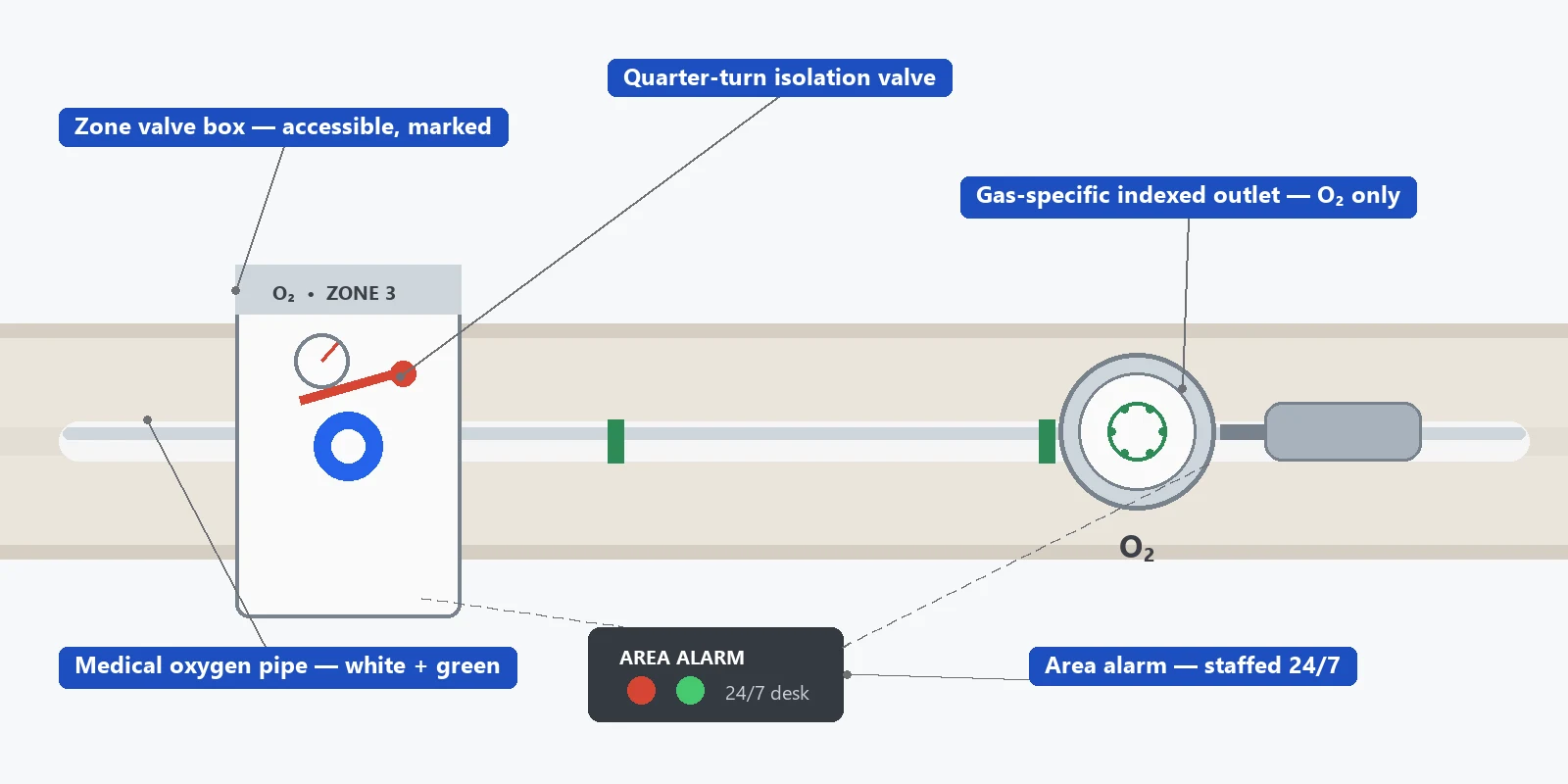
Hospital directors and facility managers are rarely medical gas specialists — but they are the ones who sign the licensing file and answer for patient safety. The good news: you do not need to be an engineer to verify the essentials. NFPA-99 (with ISO 7396-1 as the international counterpart) gives a clear framework, and a short walk through your facility with the right questions exposes most systemic problems. Here are the six checks we recommend every hospital leader personally performs or commissions.
1. Source equipment and reserves
Stand at the oxygen manifold or plant room and ask: what happens when the primary supply runs out in the middle of the night? There should be an automatic changeover to a secondary supply, a reserve bank sized for the critical load, and pressure gauges that are readable and obviously working. If the answer depends on someone noticing a gauge, the system is not automatic — it is hopeful.
2. Alarms that reach a human
NFPA-99 requires master and area alarms for line pressure — high and low — at source and on each zone. The single most common audit finding in Bangladeshi facilities is not missing alarms; it is alarms wired to a panel in a locked plant room or an unmanned engineering office. Trace one alarm from sensor to audible signal to a staffed desk, and press the test button yourself.
3. Zone valves, access and labeling
Zone valves allow sections of the pipeline to be isolated for maintenance without shutting down the whole hospital. Verify three things: the valves are accessible (not behind storage), correctly labeled by zone and gas, and — after any maintenance — demonstrably reopened. A zone valve left closed after filter replacement has caused more clinical emergencies than most equipment failures.
4. Gas-specific connections
Every outlet and inlet must accept only the correct probe for its gas — the DISS and gas-specific indexing standards exist precisely because cross-connections are lethal. Ask for the most recent cross-connection test report. If the report does not exist or is more than a few years old, this is your highest-priority finding.
5. Independent verification testing
Pipeline verification — pressure testing, cross-connection testing, outlet performance and alarm function — should be performed by a party independent of the installer, and documented. This mirrors the NFPA-99 verification model. The paperwork matters: it is what licensing authorities ask for first, and what protects the institution after an incident.
6. People, not just pipes
- Is there a named, trained person responsible for the medical gas system — and a deputy?
- Are maintenance staff trained on brazing and purge procedure requirements for medical gas work?
- Is there a change log for any pipeline modification, however small?
“A medical gas system is one of the few hospital systems that touches every patient, every day, invisibly. Verification is how you make the invisible accountable.”
These six checks take an afternoon and reveal the condition of the system behind the walls. For facilities preparing for DGHS licensing in Bangladesh — or JCI-style accreditation anywhere — they are also the fastest route from "we think it works" to "we can prove it works."